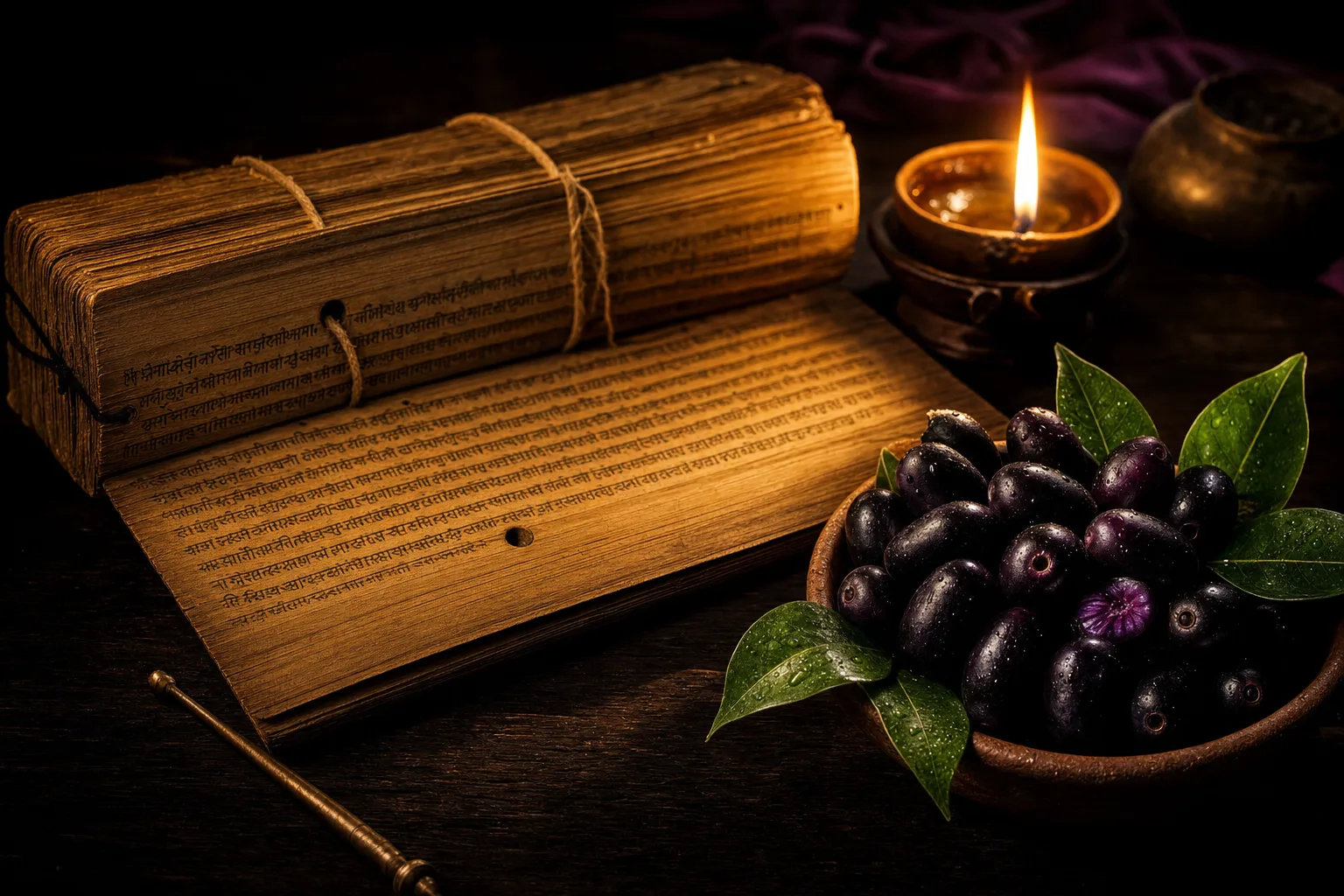
For more than two thousand years, Indian physicians have prescribed the dark-purple fruit of Syzygium cumini for diabetes, dysentery, hemorrhage and burning thirst. The case for jamun was made — chapter by chapter, leaf by leaf — long before HbA1c was a number anyone could measure.
Jambu: the Sanskrit name and its weight
The Sanskrit word for jamun is Jambu (जम्बू). It is one of the oldest plant names in the Indo-European medical canon, with synonyms running into the dozens: Mahaskandha (great trunk), Surabhipatra (fragrant leaf), Mahaphala (great fruit), Neelaphala (blue-black fruit), Shyamala (dark-complexioned), Meghamodini (appearing in rainy season), Pikabhaksha (food of cuckoos), and Rajajambu (king jamun) (Rasamruta comparative study of Jambu varieties).
The classical Nighantus — the Sanskrit pharmacopoeias — distinguish at least five species under the Jambu umbrella: Mahajambu (the true Syzygium cumini), Kshudrajambu, Kakajambu, Bhumijambu, and Jalajambuka. The variety SVBS grows — Konkan Bahadoli — descends from the Rajajambu lineage: large fruit, sweet pulp, deep colour.
Rasa Panchaka: how Ayurveda categorises a fruit
Every herb in Ayurveda is described by its rasa panchaka — five inseparable attributes. For jamun, these are remarkably consistent across Planet Ayurveda, the SDACH Ayurveda College's Dravyaguna materia, and the LiveAyurved compendium:
| Attribute | Sanskrit | Value |
|---|---|---|
| Rasa (taste) | रस | Kashaya (astringent) + Madhura (sweet) + Amla (sour) |
| Guna (quality) | गुण | Laghu (light), Ruksha (dry) |
| Virya (potency) | वीर्य | Sheeta (cold) |
| Vipaka (post-digestive) | विपाक | Katu (pungent) |
| Prabhava (special action) | प्रभाव | Prameha-ghna — specific antidiabetic |
| Dosha effect | — | Kapha-Pitta-hara; mildly Vata-vardhaka |
Read together, the profile describes a fruit that cools, contracts, and dries — exactly what classical physicians wanted when treating excess thirst, loose stools, internal bleeding, and the wasting condition known as Prameha.
The Charaka Samhita: jamun for blood and urine
The Charaka Samhita, traditionally placed around 300–200 BCE, is the foundational text of internal medicine in Ayurveda. It refers to jamun under the name Jambukoora and describes it as rakta-shodhana — a blood purifier — and pachana — a digestive aid (Ask Ayurveda's Syzygium cumini monograph).
More importantly, Charaka classifies jamun under Mutrasangrahaneeya Dravya — the group of urinary astringents. This is the technical reason jamun appears throughout the Prameha Chikitsa (chapter on diabetic-spectrum disorders): patients with what we now call diabetes mellitus produce excessive urine, and a Mutrasangrahaneeya herb is meant to restrain that flow at its source. A modern review of Ayurvedic prameha protocols summarises the passage:
Herbs such as Shilajit, Khadir, Lodhra, Guduchi, and Jambu have proven effective in controlling Madhumeha. JETIR review on Ayurvedic management of Prameha (JETIR 2025 paper)
Charaka also notes jamun in agricultural observation contexts — its fruiting was used as an indicator of the right season for sowing yavaka (barley) (WisdomLib's Charaka cross-reference). Two and a half thousand years before phenology became a science, jamun was already a working calendar.
The Sushruta Samhita: jamun against haemorrhage
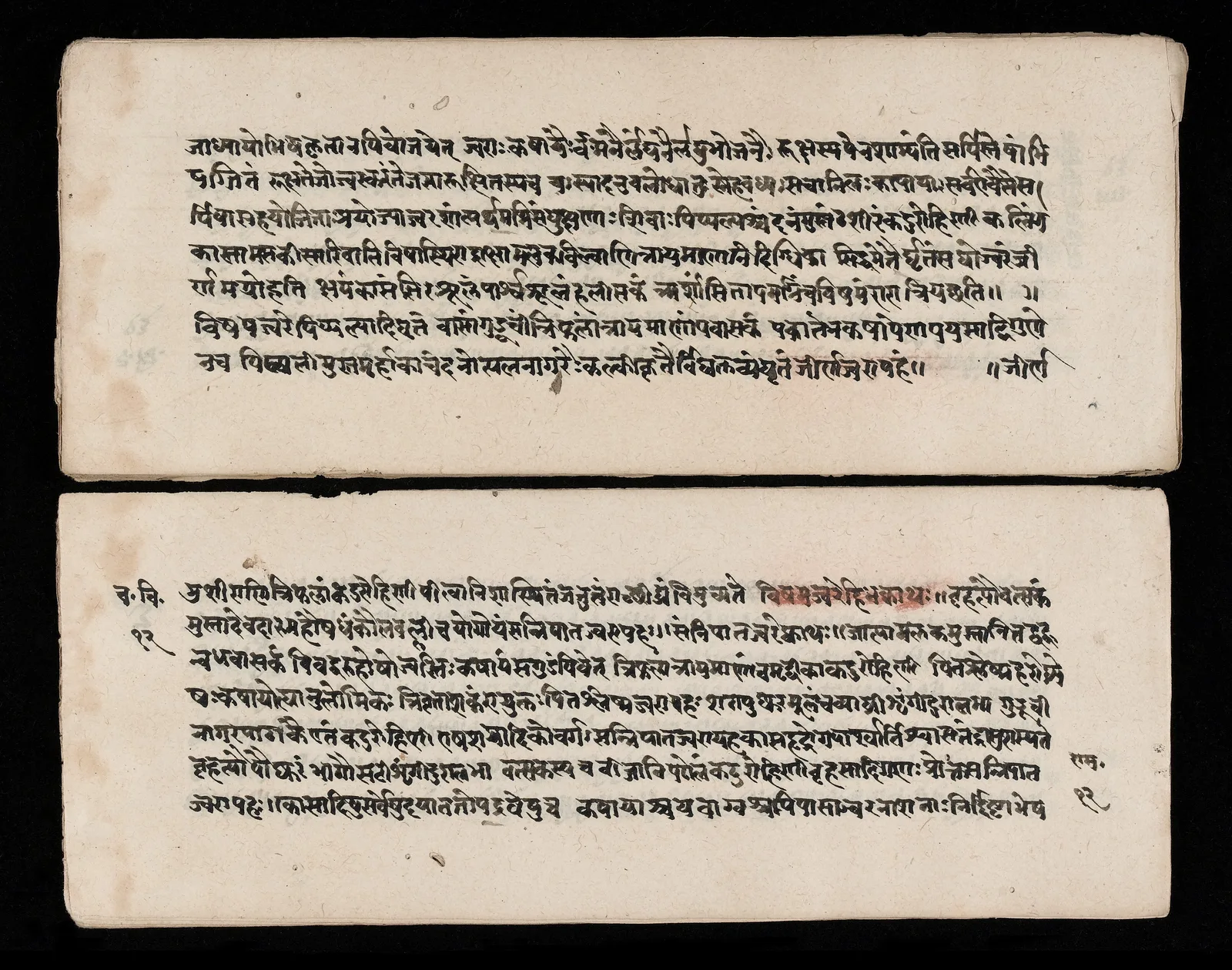
The Sushruta Samhita, the surgical companion to Charaka, is even more explicit. The authoritative WisdomLib translation indexes jamun at five separate references in the text — 1.141.14, 1.157.19, 2.78.21, 2.106.12 and 2.150.17 (WisdomLib's Sushruta Jambu citations). The richest of these is in the Uttara Tantra, Chapter 45, the chapter on Rakta-pitta — internal haemorrhagic disorders.
A cold infusion of Jambu, Amra and Arjuna should be taken with honey... A compound consisting of flowers of Khadira, Jambu, Arjuna, Kovidara, Shirisha, Lodhra, Asana, Shalmali and Shigru, pounded together and mixed with honey, should be licked by the patient in a case of Rakta-pitta... The decoction of Jambu, Arjuna and Amra — these three compounds prove curative in cases of Rakta-pitta. Sushruta Samhita, Uttara Tantra Ch. 45 (WisdomLib translation)
The same chapter even uses ripe jamun fruit as a clinical colour comparator — describing untreatable haemorrhage as resembling "a ripe Jambu-fruit." That a Sanskrit surgeon used the fruit's exact pigment as a diagnostic reference says everything about how familiar it was at the bedside.
Sushruta's Cikitsasthana also lists jamun among the Salasaradi Gana — the herb group selected specifically for prameha management — in a shilajatu-based decoction (JETIR Prameha review).
Vagbhata and the Ashtanga Hridayam
In the 7th-century Ashtanga Hridayam, the master Vagbhata praises the astringent fruit of jamun for managing disorders of Kapha and Pitta doshas (Ask Ayurveda compilation). His specific classifications:
- Grahi — absorbent of fluids and secretions; therefore useful in Atisara (diarrhea).
- Dahaprashamana — relieving burning sensation; therefore useful for Pitta-derived heat, including the diabetic Daha that modern doctors recognise as peripheral neuropathic burning.
- Raktapittahara — pacifying disorders of blood and Pitta.
Bhavaprakasha and the three varieties
The 16th-century Bhavaprakasha Nighantu distinguishes three forms of edible jamun: Madhura (sweet), Madhuramla (sweet-sour), and Amla (sour) — anticipating, by four centuries, what modern horticulturists call cultivar selection. It also documents Jalajambu — water-loving jamun — under the synonyms Kshudrajambu, Sookshmapatra and Nadeyi (Rasamruta study).
Bhavaprakasha's description of Jalajambu's actions reads like a clinician's checklist: Sangrahi (absorbent), Ruksha (drying), Kapha-pitta-rakta-vikar-hara (subsides Kapha, Pitta, and blood disorders), and Dahajith (overcomes burning sensation) (Ilkogretim Online review of Ayurvedic fruits).
Bhaishajya Ratnavali: jamun in combination
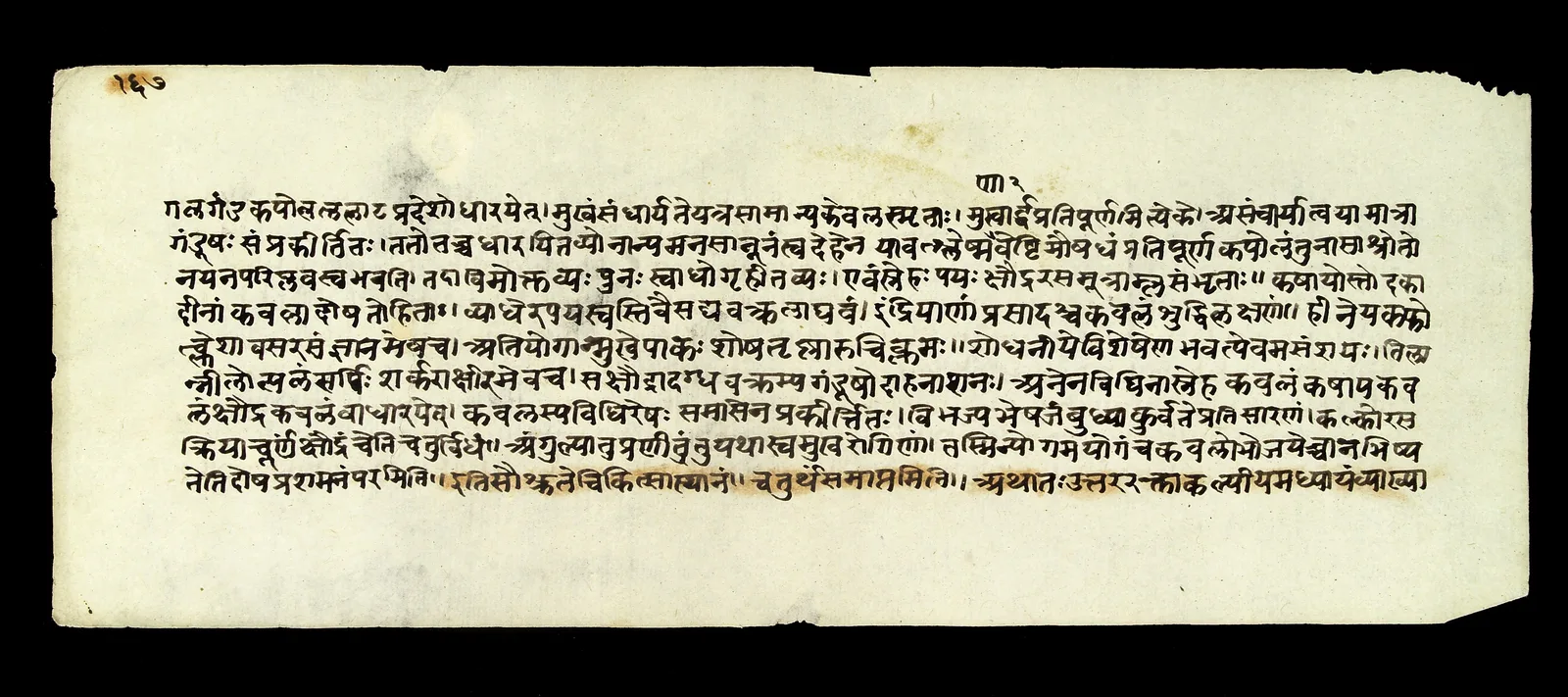
By the time of the medieval formulary Bhaishajya Ratnavali, jamun has stopped travelling alone. It is named as the keystone ingredient in compound antidiabetic formulations alongside karela (bitter melon, Momordica charantia) and methi (fenugreek, Trigonella foenum-graecum) — a synergy modern pharmacologists are still pulling apart in the lab (Ask Ayurveda monograph).
The consolidated indications
Across Charaka, Sushruta, Vagbhata, Bhavaprakasha, the Nighantus and Bhaishajya Ratnavali, the indications converge into a remarkably consistent list — drawn from SDACH Ayurveda, LiveAyurved, and the WisdomLib concept of Jambu:
| Indication | Sanskrit term | Part used |
|---|---|---|
| Diabetes / urinary disorders | Prameha, Madhumeha, Ikshumeha | Seeds, fruit |
| Diarrhea | Atisara | Seeds, bark |
| Bleeding disorders | Raktapitta | Fruit, flowers, bark |
| Burning sensation | Daha | Fruit pulp |
| Vomiting | Chardi | Fruit juice |
| Wounds / ulcers | Vrana | Bark powder |
| Leucorrhoea | — | Bark decoction |
| Fever | Jwara | Multiple parts |
Where SVBS fits in
Ayurvedic formulators, nutraceutical manufacturers, and bottled-juice producers are our largest segment of buyers. Our 40-acre Konkan Bahadoli grove yields fruit with consistent pulp-to-seed ratio and predictable anthocyanin density — making it suitable for fresh dispatch, frozen pulp, and dried seed-powder lines. We welcome buyer audits.
The continuity
Two thousand years separate the Charaka Samhita from a PubMed paper on jamboline. The vocabulary differs — Mutrasangrahaneeya versus α-glucosidase inhibition — but the clinical observation is identical. A patient who urinates excessively, who burns from within, who carries sweetness in his urine: he is treated with jamun. Then and now.