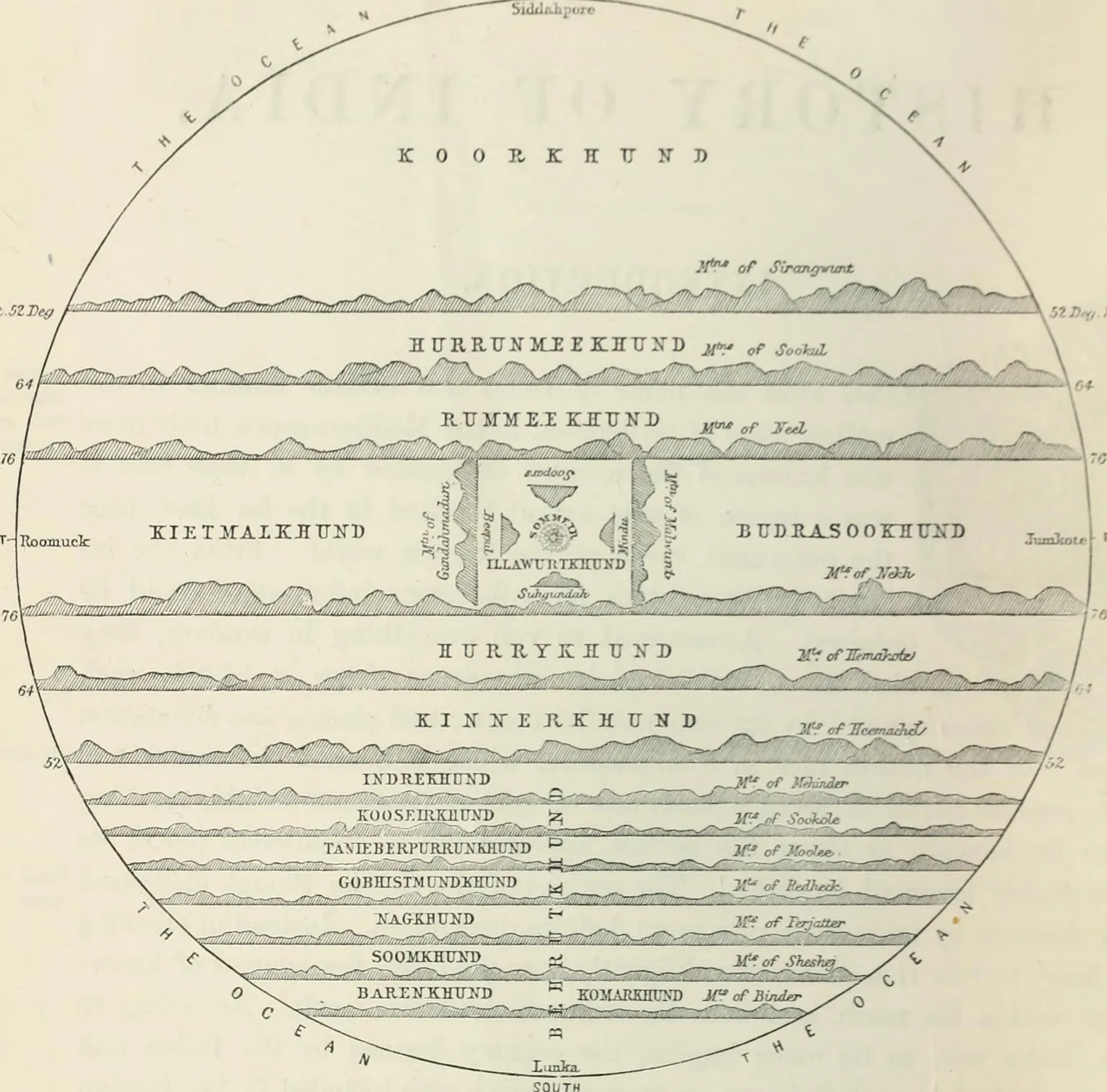
India is not, in its oldest self-description, "India." It is Jambudvipa — the island of the jamun tree. The fruit you eat on a hot afternoon was, in the cosmology of the Puranas, the centre of the universe.
The word, and what it means
The Sanskrit Jambu-dvīpa (जम्बुद्वीप) translates literally as "continent of the Jambu tree." It is one of the seven concentric continents in the classical Hindu cosmographic scheme — and it is the innermost one, where mortals live, where rishis composed verse, and where Vishnu's avatars walked the earth (Wikipedia entry on Jambudvipa).
The name is not poetic embellishment. The Puranic geographers fixed the etymology directly: the continent is named because a colossal Jambu tree stands at the centre of its central mountain, Mount Meru, and its fruits — falling onto the slopes and bursting into juice — are the source of the river Jambunadi and of the golden ore Jambunada from which celestial ornaments are made.
The Vishnu Purana account
The most quoted passage is from the Vishnu Purana, Chapter II.2:
On each of these mountains stands severally a Kadamba-tree, a Jambu-tree, a Pipal, and a Vata; each spreading over eleven hundred yojanas, and towering aloft like banners on the mountains. From the Jambu-tree the insular continent Jambu-dvīpa derives its appellation. The apples of that tree are as large as elephants: when they are rotten, they fall upon the crest of the mountain, and from their expressed juice is formed the Jambu river, the waters of which are drunk by the inhabitants; and in consequence of drinking of that stream, they pass their days in content and health, being subject neither to perspiration, to foul odors, to decrepitude, nor organic decay. Vishnu Purana II.2 (via Vasumathi R's Puranic translation notes)
Read this passage closely. The Puranic authors were attributing to the jamun fruit and its juice three specific properties: contentment, health, and absence of decay — the same broad category of claims that modern researchers now investigate under the names "antioxidant," "anti-glycative," and "anti-inflammatory."
The passage continues: "The soil on the banks of the river, absorbing the Jambu juice, and being dried by gentle breezes, becomes the gold termed Jāmbūnada, of which the ornaments of the Siddhas are fabricated." The deep purple pigment of the fruit — the same anthocyanins we now bottle — becomes, in metaphor, alchemy.
The Bhagavata Purana: the river and the gold
The Bhagavata Purana (Srimad Bhagavatam, Canto 5) is even more precise about the geography. At 5.16.19–20:
Jambū (Jāmbūnada): a river of juice of celestial rose-apple tree flowing from the top of Merumandara into Ilāvṛta. The earth on its two banks yields fine gold jāmbūnada, from which jewels are made in heaven. Bhagavata Purana V.16.19–20 (WisdomLib Jambu definitions)
And at 5.1.32, the Bhagavatam fixes Jambudvipa's place in the universe:
Jambūdvīpa occupies the central position of the globe in the form of a lotus leaf, in extent a 100,000 yojanas. There are nine continents demarcated by mountain ranges. In the middle is situated Ilāvṛta, at whose middle portion stands Meru. Bhagavata Purana 5.1.32 (Soolaba Blog summary)
Devi Bhagavata and the alchemical gold
The Devi Bhagavata Purana (Skandha 8) elaborates the same image with technical specificity:
The juice of the Jambū fruit when mixed with soil and acted upon by water, air and sun's rays, turns into a kind of gold called Jāmbūnada. The devas, Vidyādharas etc. use this gold to make ornaments for their women. This gold is superior to other kinds of gold. Devi Bhagavata Purana, Skandha 8 (via WisdomLib)
Modern chemistry can read this with a smile. The jamun fruit contains delphinidin, malvidin, petunidin, cyanidin and pelargonidin — the five anthocyanidins responsible for the deep purple colour and a substantial share of the fruit's antioxidant capacity. When the Puranic authors wrote of the soil "turning to gold" after absorbing jamun juice and being acted upon by water, air and sun, they were describing — in mythological metaphor — exactly the kind of slow polyphenol-driven oxidative transformations that produce coloured iron, manganese and copper compounds in soil.
Across the Puranas
The image of the Jambu tree as cosmic axis recurs across the Puranic corpus:
- Brahmanda Purana (II.17.12; 19.29; III.22.37; 27.17; IV.43.17): identifies the Jambu tree at Ilavrta in the Himalayas.
- Markandeya Purana and Brahmanda Purana: divide Jambudvipa into four vast regions shaped like four petals of a lotus, with Mount Meru at the centre (Wikipedia entry on Jambudvipa).
- Shiva Purana and Agni Purana: both describe the Jambu river flowing around Mount Meru, depositing golden ores (WisdomLib River Jambu).
- Linga Purana: describes the Jambu river circling the base of the great mountain Meru.
- Parakhya Tantra 5.61 (Shaiva tradition): "All this is called the continent Jambu, where the Jambu tree with large fruits grows. Because of contact with the juices that come from those arises the gold known as Jāmbūnada. Outside that is the ocean of salt water that was created by the sons of Sagara."
Ashoka makes it political
The word was not confined to mythology. In the 3rd century BCE, the emperor Ashoka — at the height of the Mauryan empire — used the name Jambudvipa in his stone edicts to describe his realm. This is a historical fact, not legend. It means that for at least 2,300 years, "Jambudvipa" has been a working geographic and political term for the Indian subcontinent (Wikipedia entry on Jambudvipa).
The Jain testimony
The Jain tradition is no less explicit. The Tattvarthasūtra 3.10 states plainly:
Jambū is the name of the tree enveloping the continent of Jambūdvīpa: the first continent of the Madhya-loka. Tattvarthasūtra 3.10 (via WisdomLib)
The Jain canonical text Jñātādharmakathāṅga-sūtra (3rd century BCE) identifies jamun as a fruit (phala) grown and consumed in ancient India, with explicit mention of fruit-drying and preservation operations at the Koṭṭaka. Two millennia before refrigeration, Indians were already drying jamun for the off-season.
Ramayana, Mahabharata, Mahavamsa
The two great epics cite the Jambu tree repeatedly. The Valmiki Ramayana at 2.55.15; 2.91.49; 3.17.8; 4.44.56 — and the Mahabharata at 1.7587; 13.635; 3.11569 (WisdomLib Jambu definitions). Popular tradition holds that Lord Rama subsisted on jamun fruit during much of his fourteen-year forest exile, earning the fruit the epithet devaphala — fruit of the gods.
The Sri Lankan chronicle Mahavamsa tells a similar story about King Samgatissa, who is reported to have eaten jamun fruits in a famous episode preserved in the island's traditional literature (Tamil and Vedas — Jambu tree compilation).
A note on verification
The Rama-jamun association is widely cited in oral tradition; the specific Valmiki verse naming jamun as Rama's sustenance is contested by some scholars, who place it in later Puranic additions rather than the core Valmiki text. The Vishnu Purana and Bhagavata Purana etymologies, however, are textually firm.
Why this still matters
Take a single jamun fruit from a Marripadu basket in July. It is connected — by name, etymology and metaphor — to one of the oldest cosmological vocabularies still in active use. The Purana you read, the empire Ashoka administered, the philosophy the Jains canonised, the deccan plateau you stand on: every one of them is named after this tree. Eating jamun in India is, in the most literal sense, an act of citizenship.