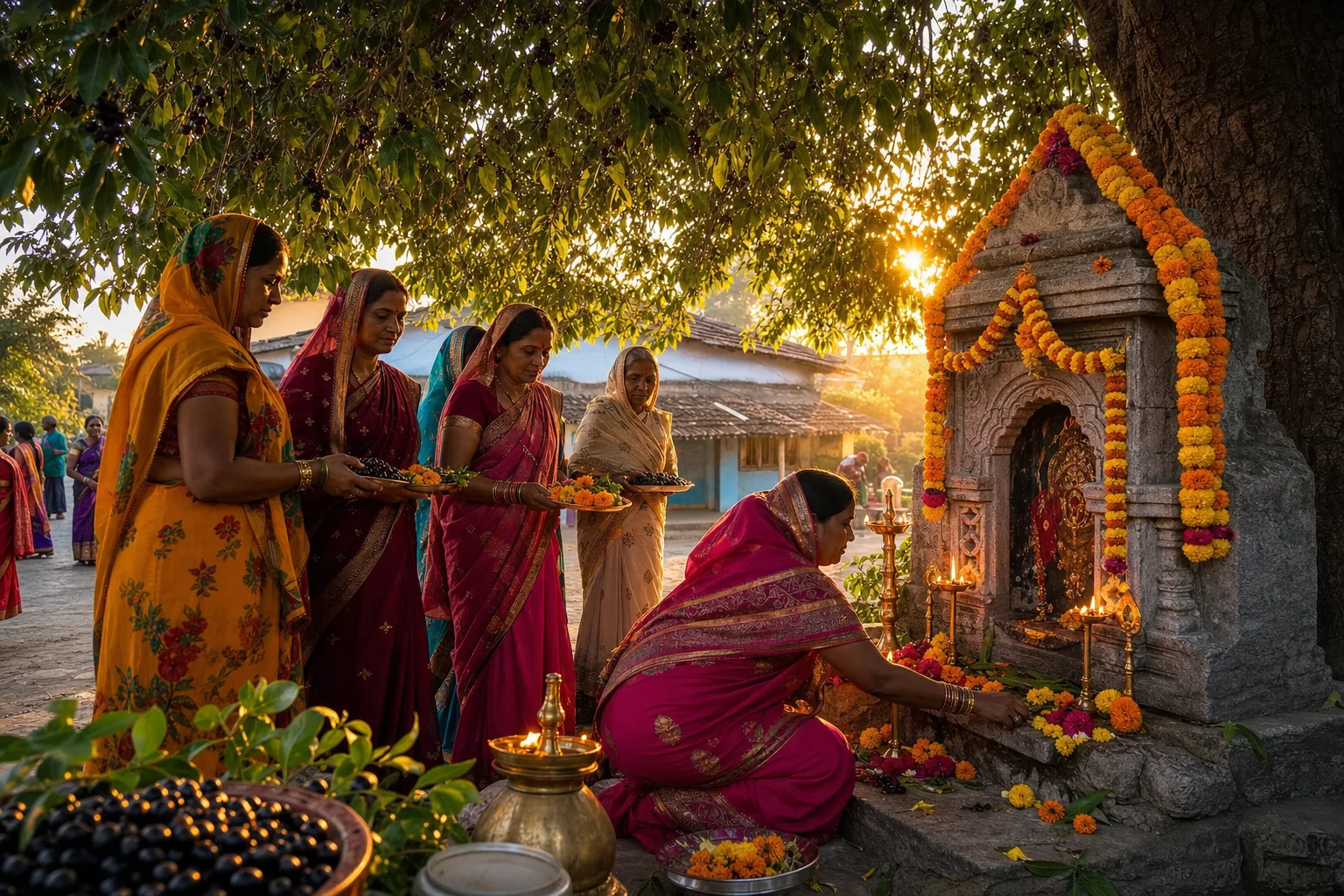
A fruit ripens in July. A festival opens in Ashada Masam. A goddess receives an offering under a tree whose name the continent was built around. This is jamun in the lived culture of the Deccan — not as theory, but as practice.
Neredu Pandlu: the Telugu inheritance
In Telugu, jamun is నేరేడు పండ్లు — Neredu Pandlu. The fruit is wound deeply into the cultural fabric of Andhra Pradesh and Telangana, where summer markets are studded with vendors selling small purple-black mounds of fruit from large baskets:
Jamun, known as 'Neredu Pandlu' in Telugu, is a seasonal fruit highly regarded in Andhra Pradesh for its unique taste, medicinal properties, and cultural significance. This purple-black fruit, with its sweet and slightly tangy flavor, is commonly consumed fresh, and its seeds, bark, and leaves are also used in traditional medicine. The fruit is harvested locally during the summer season. Jamun — Neredu Pandlu uses in Andhra Pradesh (Scribd compilation)
The jamun tree is planted along village roadsides and homestead boundaries — both as an avenue tree giving shade through the hottest months, and as a productive food source in season. Its wood is used for agricultural implements, furniture and construction in rural Andhra Pradesh. The tree, in other words, is not ornamental. It is infrastructure.
Bonalu: Telangana's harvest festival
Bonalu (బోనాలు) is the great folk festival of Telangana, celebrated in Ashada Masam — the lunar month that runs roughly from July through August — in honour of Goddess Mahakali in her many regional forms: Yellamma, Mysamma, Pochamma, Pedamma, Poleramma, Ankalamma, Maremma. The festival is centred on the twin cities of Hyderabad and Secunderabad, but is celebrated across the state.
Bonalu is a traditional festival centred on the Hindu goddess Mahakali from Telangana. This festival is celebrated annually in the twin cities of Hyderabad and Secunderabad, as well as in other parts of the state. It is celebrated in the month of Ashada Masam, which is around July and/or August... Women prepare rice cooked with milk and jaggery in a new brass or earthen pot adorned with neem leaves, turmeric, and vermilion with a lit lamp on top of the pot. Wikipedia — Bonalu (source)
The timing is not coincidental. Bonalu falls in the exact weeks when jamun trees across the Deccan plateau are laden with ripe fruit. Seasonal offerings to the Goddess during Bonalu include the fruits that the season makes available — and jamun, along with mango and seasonal grain, sits among them (Hyderabad District — Bonalu).
For a farmer in Marripadu, the convergence is not abstract. The harvest that we ship in tonnes to wholesalers in Madanapalle and Bangalore is the same fruit that village women across Telangana carry on their heads in bonam pots to the temple, and the same fruit that families share in baskets at home.
Krishna and the colour of the cloud
Lord Krishna is described in the Bhagavatam and the broader Vaishnava tradition by two epithets that connect him directly to jamun: Ghanashyama (घनश्याम, "dark like the rain cloud") and Shyama (श्याम, "dark-complexioned"). The Sanskrit word Krishna itself means "the dark one."
Shyama color is not exactly blackish. Shrila Bhaktisiddhanta Sarasvati Thakura compares it to the color of the atasi flower... Ghanashyama means 'dark like the cloud.' Krishna's Mercy — Four comparisons used for Krishna's complexion (source)
The jamun fruit, with its deep blue-black skin, is one of the most direct visual analogies in the Indian visual vocabulary for the colour Krishna is said to bear. The Sanskrit synonym Shyamala — "dark-complexioned" — appears explicitly in the Nighantus as a name for jamun. Meghamodini — "she who draws the clouds" — is another, linking the fruit to Krishna's cloudlike darkness. Eat a jamun and your tongue is, for a few minutes, the precise shade of the divine.
The Rohini nakshatra connection
Hindu astronomy assigns each of the twenty-seven lunar mansions (nakshatras) a presiding deity, an animal, and — in the classical schemes — a tree. The jamun tree is associated with the Rohini nakshatra, whose presiding deity is Brahma. Rohini is one of the most auspicious nakshatras, linked to fertility, growth and abundance.
The tree is considered sacred and worshipped by Hindus and venerated by Buddhists. Jamun represents the god of clouds or Megha. The leaves are used as platters or panchpallavs and for pouring libations. For the Todas of Nilgiris the tree is sacred — often grown near the temples and never cut. Leaves of this tree are strung into garlands and hung over the entrance doors of houses for perpetuity and continuity of stable marriage. The fruits are also offered in worship. Sacred Trees BHU — Black Plum entry (source)
The Sthala Vriksha tradition
In the Tamil and broader South Indian temple tradition, each major shrine is associated with a specific Sthala Vriksha — the temple tree — believed to be a physical manifestation of the deity's presence. The jamun tree is the Sthala Vriksha of several Shaiva temples in South India, most famously the Jambukeshvara Temple at Thiruvanaikaval, near Tiruchirappalli.
Jambukeshvara — literally "Lord of the Jambu tree" — is one of the five Pancha Bhuta Stalas: the five temples representing the five great elements. Jambukeshvara represents Appu or Jala — Water. The temple's central iconography is built around an underground spring that perpetually moistens the lingam, and around the great jamun tree said to grow at the site.
The Parakhya Tantra (a Shaiva scriptural text) preserves the foundational legend:
Goddess Pārvatī in the name of Akilānṭeśvarī would come there and worship the linga. The sage went to Tiruvānaikoyil and stayed there. The seed of the rose apple sprouted from his head and grew into a big jambu tree under which the liṅga was worshipped by Akilānṭeśvarī. Parakhya Tantra (via WisdomLib)
The Tamil naval and the Sri Lankan naval
In Tamil Nadu, jamun is நாவல் — naval. The Tamil tradition shares with the Sanskrit Puranic tradition the conviction that India itself — Jambudvipa — is named for this tree:
India's name is Jambudvipa meaning Land of Indian Blackberry Tree. Tamil and Vedas — Jambu tree compilation (source)
In Sri Lanka, where the language and the religious tradition both descend from peninsular India, jamun is also called naval (or madan). The Sri Lankan tradition of using jamun leaves soaked overnight in water for children's digestive complaints is a folk medicine practice that has been preserved across centuries.
The Bengali Kala Jam
In Bengal, jamun is কালো জাম — Kala Jam, "black berry." The Bengali experience of the fruit is overwhelmingly seasonal and sensory: stained tongues, summer afternoons, sudden monsoon showers, baskets of dark fruit at the local market. The tree is locally common, and the fruit features in folk songs, in children's rhymes, and in the broader Bengali cultural identification with the monsoon's arrival.
Bhumi Pooja and the consecration of land
In the Hindu agricultural and construction traditions, Bhumi Pooja — the ceremony of earth-worship — opens any major undertaking that breaks ground: a building foundation, a temple construction, a new planting. The ceremony invokes Bhumi Devi (the Earth Goddess) and asks her blessing on the land that is about to be disturbed. Sacred trees — including jamun, peepal, banyan, neem, and amla — are honoured in this context.
Within the SVBS grove, several jamun trees stand close to the small shrine where Bhumi Pooja was performed before each generation's planting. The trees are not part of the productive 40-acre block; they are part of the place. The continuity is direct: from Charaka's text, through the Puranic geography, to the Telangana goddess festival, to the local stone shrine and the basket of fruit beside it.
Why the cultural matters to the buyer
When you buy jamun, you are buying a fruit with cultural weight that no marketing campaign created. The Bonalu festival sells your product in late July without your spending a rupee on advertising. The Ayurvedic clinician who recommends jamun seed powder to her patients is drawing on two thousand years of unbroken cultural transmission. This is why jamun, as a category, has remarkable customer loyalty across age groups and regions — and why a steady supply from a reliable farm matters more than seasonal pricing games.
The grove in the system
Our 40 acres near Madanapalle — Marripadu Village, Annamayya District, Andhra Pradesh — sit inside this longer story. The grove is not a plantation in the modern monoculture sense; it is, in the older sense, a continuation of a sacred tree's productive role in Indian life. The fruit you ship out in July is the same fruit Charaka named, Sushruta prescribed, Ashoka invoked, the Vishnu Purana described, the Bonalu festival receives, and Krishna's complexion echoes.
It is, in the most literal sense, the fruit of Jambudvipa.