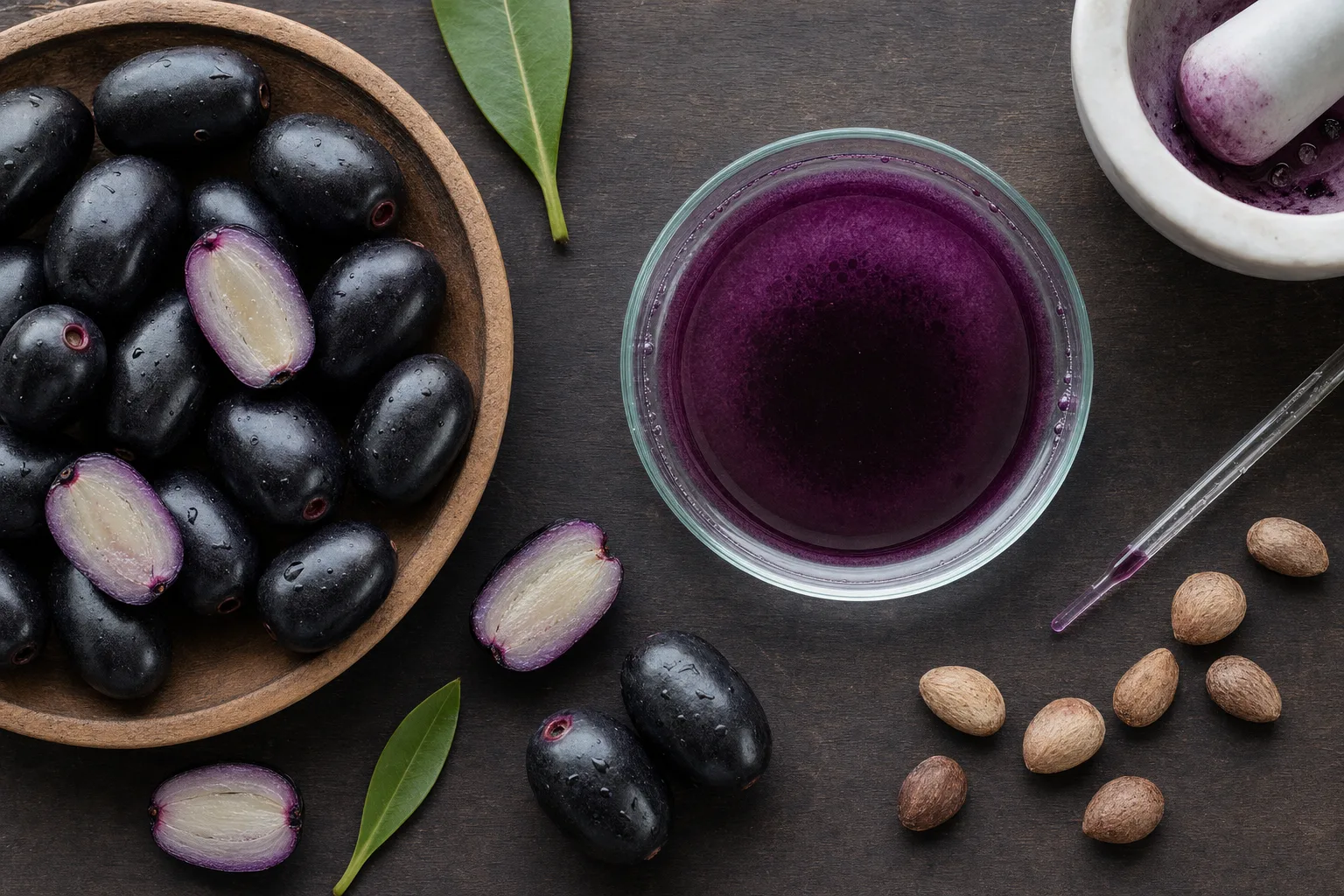
If you formulate Ayurvedic medicines, bottle juice, or extract for the nutraceutical market, you need to know what is in the fruit before you specify what you are buying. Here is the phytochemical map — plant part by plant part.
Why this matters to a buyer
Jamun is not one ingredient. It is a family of ingredients distributed unevenly across the fruit, seed, leaf, bark and flower. Buying "jamun" without specifying part and processing method is like buying "cattle" without specifying whether you want milk, leather, or meat. This article maps which bioactive lives where, so that a formulator's specification — and a supplier's quality guarantee — can match.
The three foundational reviews behind everything here are Chagas et al. 2015 in Frontiers in Pharmacology, Ayyanar & Subash-Babu 2012 in Asian Pacific Journal of Tropical Biomedicine, and Rizvi et al. 2022 in Molecules.
The five compound classes
Every important bioactive in jamun falls into one of five chemical families. Knowing the families is the entry-point to knowing the molecule:
1. Alkaloids — seed
The seed is the principal reservoir of jamun's antidiabetic alkaloids:
- Jambosine — α-glucosidase inhibition; slows the conversion of dietary starch to glucose at the small-intestine brush border.
- Jamboline (also called antimellin) — a glycoside that halts the diastatic conversion of starch into sugar in the gut lumen itself.
The Ayyanar–Subash-Babu summary is unambiguous:
The seeds are claimed to contain alkaloid jambosine, and glycoside jamboline or antimellin, which halts the diastatic conversion of starch into sugar. Ayyanar & Subash-Babu, 2012 (PMC3609276)
2. Phenolic acids — multiple parts
Gallic, ellagic, chlorogenic, caffeic and ferulic acids are distributed across fruit, seed, leaf and bark in varying concentrations:
| Compound | Plant part | Key action |
|---|---|---|
| Gallic acid | Fruit, seeds, bark | Antioxidant; topoisomerase-I inhibitor; anti-mutagenic |
| Ellagic acid | Fruit, seeds, flowers | Anti-inflammatory; neuroprotective; cardioprotective |
| Chlorogenic acid | Leaves | Antioxidant; platelet protection |
| Caffeic acid | Seeds, leaves | Antihyperglycemic; supports glycogen synthesis |
| Ferulic acid | Seeds, leaves | Antioxidant |
3. Flavonoids — across the plant
Jamun is unusually flavonoid-dense:
| Compound | Plant part | Key action |
|---|---|---|
| Myricetin | Leaves, seeds, fruit, flowers | Vasodilation; GLUT-4 upregulation; aldose reductase inhibition |
| Quercetin | Seeds, flowers, bark | Insulin secretion (L-type Ca²⁺ channels); antihyperlipidemic |
| Rutin | Seeds | Antihyperglycemic; insulin secretion in pancreatic islets |
| Kaempferol | Flowers, bark | Antioxidant; anticancer |
| Isoquercetin | Fruit, seeds | Antioxidant |
| Catechin | Leaves | Antioxidant |
4. Anthocyanins — fruit peel
This is where jamun is most distinctive. The deep blue-black colour of the ripe fruit comes from a concentrated load of five anthocyanidins in the peel and outer pulp (Aqil et al. 2012, PMC3351850):
| Anthocyanin | Notes |
|---|---|
| Delphinidin | Principal antioxidant anthocyanin in the fruit peel |
| Malvidin | Anti-inflammatory; characteristic of dark-purple fruit |
| Petunidin | Antioxidant; secondary |
| Cyanidin | Antioxidant; anti-inflammatory |
| Pelargonidin | Minor; orange-red end of the spectrum |
The five-anthocyanin profile, combined with ellagitannins, gives jamun fruit an Oxygen Radical Absorbance Capacity (ORAC) of 1,445 ± 64 µmol TE/g for the pulp and 3,379 ± 151 µmol TE/g for the seed. The seed extract achieves approximately 90% DPPH radical inhibition at just 50 µg/mL. Anthocyanin content in the fruit averages 5.32 ± 0.31 mg cyanidin-3-glucoside-equivalents per gram of fresh fruit (Rizvi et al. 2022, PMC9654918).
5. Tannins — seed and fruit
The astringency of jamun — the cause of the characteristic puckered tongue after eating — comes from a heavy load of hydrolysable tannins, concentrated in the seed:
| Compound | Plant part | Notes |
|---|---|---|
| Corilagin | Seeds | Hydrolysable tannin; potent antiviral activity in screening studies |
| HHDP-glucose forms | Seeds, fruit | 3,6- and 4,6-HHDP glucose; ellagitannins |
| Galloylglucose forms | Seeds, fruit | 1-, 3-galloylglucose; trigalloylglucose |
| Nilocetin | Leaves | Leaf-specific tannin |
6. Terpenes and steroids — seed and bark
The terpene and steroid fraction provides several additional bioactives:
- Betulinic acid (seeds, bark) — α-amylase inhibition; anticancer activity in screening studies.
- Oleanolic acid (flowers) — antidiabetic via glycogen-synthase effect.
- β-sitosterol (multiple parts) — cholesterol regulation.
- Friedelin (bark) — anti-inflammatory.
- Eugenol (flowers, seeds) — antimicrobial; the same molecule that defines clove oil.
- Lupeol (seeds) — antimicrobial; in molecular-docking studies it shows the highest binding energy against B. subtilis membrane enzymes.
The buyer's map
Read across the five families and the picture clarifies:
| Plant part | What it is rich in | Best for |
|---|---|---|
| Fruit pulp | Gallic acid, ellagic acid, isoquercetin | Juices, jams, frozen pulp lines, food colouring |
| Fruit peel | Five anthocyanidins, ellagitannins | Antioxidant-rich beverages, natural pigment, nutraceutical anthocyanin extract |
| Seed | Jambosine, jamboline, rutin, corilagin, tannins, betulinic acid, lupeol | Antidiabetic seed-powder products; hypoglycaemic formulations |
| Leaf | Myricetin, chlorogenic acid, catechin, α-pinene, cineole | Tea preparations; antioxidant leaf-decoction products (Brazilian-style) |
| Flower | Kaempferol, myricetin, oleanolic acid, eugenol | Bee forage; aromatherapy; small-volume specialty extracts |
| Stem bark | Gallic acid, friedelin, β-sitosterol, betulinic acid | Traditional astringent preparations; wound-healing formulations |
Compiled from Chagas et al. 2015 Table 1 (PMC4630574), Ayyanar & Subash-Babu 2012, and Rizvi et al. 2022.
What this means for specification
A serious buyer specification therefore identifies:
- Plant part — fresh fruit, frozen pulp, dried peel, dried seed, dried leaf, or processed extract.
- Cultivar — Konkan Bahadoli (BSKKV release), Goma Priyanka, Paras, CISH Jamun, or local landraces. Cultivar affects pulp-to-seed ratio, sugar content, and anthocyanin density.
- Harvest stage — fully ripe (peak anthocyanin and sweetness), slightly under-ripe (higher astringency and tannin), or for specific seed-powder lines, post-harvest seed-only collection.
- Drying and processing — sun-dried versus shade-dried for seed powder; cold-pressed versus heat-pressed for pulp.
- Total phenolic content and ORAC value for premium nutraceutical specifications.
What SVBS Fruit Farms and Exports supplies
Our 40-acre Konkan Bahadoli orchard yields fruit with a consistent 25:1 pulp-to-seed mass ratio, harvested at controlled ripeness windows during the June–August peak season. We supply fresh fruit by the tonne, individually quick-frozen (IQF) pulp, and dried seed powder. Buyers requiring third-party Certificate of Analysis (CoA) for anthocyanin, polyphenol, or specific molecular markers can specify these at the time of contract.
The future of jamun phytochemistry
The decade ahead will probably see substantial work on three frontiers: (1) the bioavailability of jamun anthocyanins after oral consumption, which remains an active research question across the polyphenol literature; (2) the synergy of jamun's flavonoid cocktail versus single-isolate antidiabetics; and (3) the standardisation of seed-extract preparations so that Ayurvedic and pharmaceutical formulations can be compared meaningfully across studies.
For now, the practical knowledge is sufficient. The map exists, the molecules are characterised, and the supply chain — from grove to formulator — works. The fruit is ready.