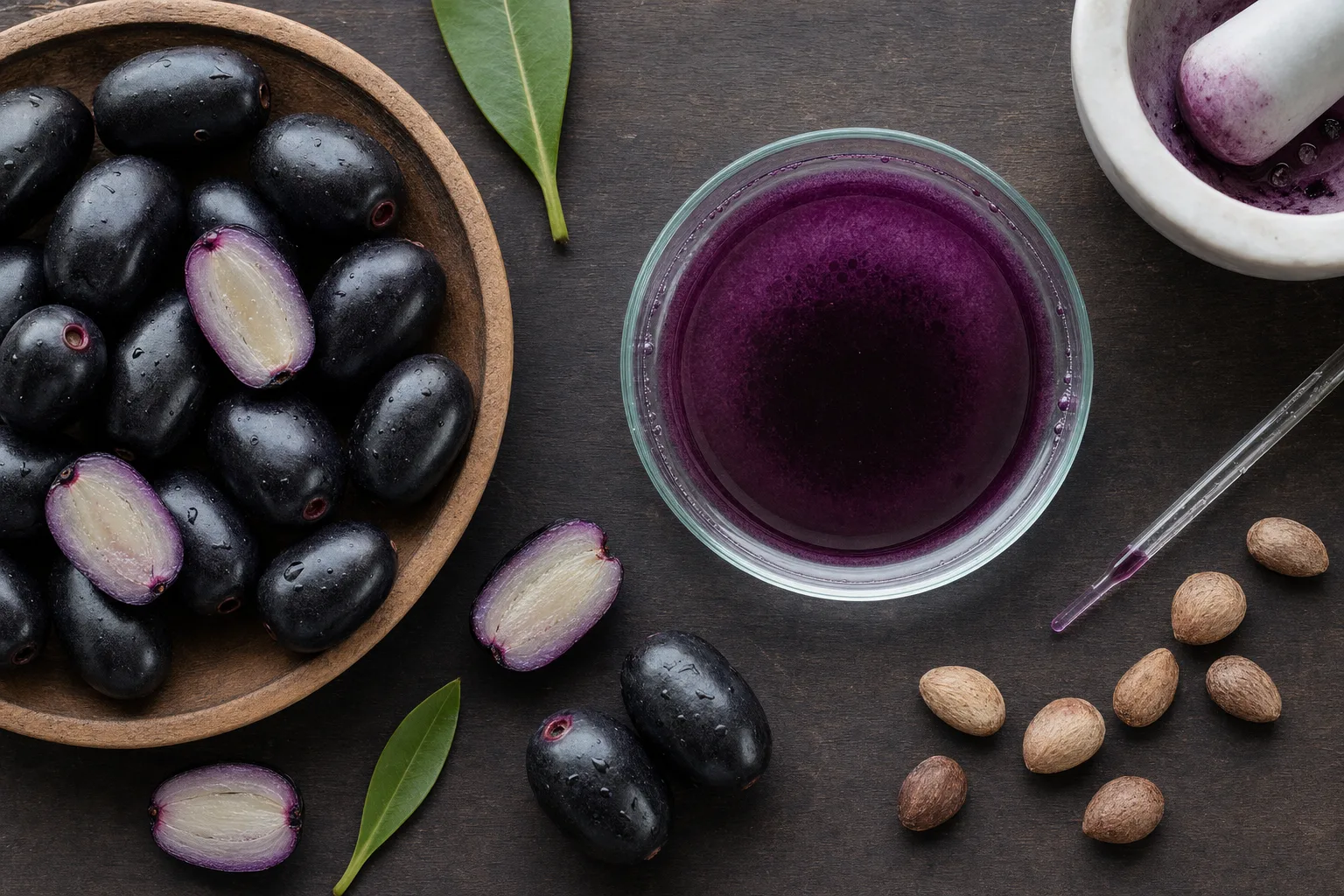
For two millennia, Ayurvedic physicians prescribed jamun seeds for Madhumeha — "honey-urine," the wasting condition whose hallmark was sweetness in the patient's urine. Beginning in the 1990s, biochemists started identifying the molecules that did the work.
The clinical problem they were solving
Type-2 diabetes is, at its biochemical core, a problem of glucose getting into the wrong places — too much in the bloodstream, too little in muscle and adipose cells where it would be safely metabolised. Pharmaceutical therapy attacks this on several fronts at once: slow the absorption of glucose from the gut (α-glucosidase inhibitors like acarbose), increase insulin production (sulfonylureas), improve insulin sensitivity (metformin, thiazolidinediones), or accelerate glucose excretion (SGLT-2 inhibitors).
The remarkable thing about jamun is that — in cell, animal and early human studies — its constituents touch every one of those mechanisms.
Jamboline and jambosine: the seed alkaloids
The most studied antidiabetic constituents of jamun are concentrated in the seed. The alkaloid jambosine and the glycoside jamboline (also called antimellin) act on the digestive cascade itself. As Ayyanar and Subash-Babu put it in their 2012 review in the Asian Pacific Journal of Tropical Biomedicine:
The seeds are claimed to contain alkaloid jambosine, and glycoside jamboline or antimellin, which halts the diastatic conversion of starch into sugar. Ayyanar & Subash-Babu, 2012 (PubMed Central PMC3609276)
In plain terms: jamboline interferes with the enzymatic breakdown of dietary starch into glucose. It works on the same general target as acarbose — the standard pharmaceutical α-glucosidase inhibitor — but as part of a much wider phytochemical ensemble.
Flavonoids and the pancreas
The fruit and seeds carry a heavy load of flavonoids. The most active for diabetes management are:
- Quercetin — promotes insulin secretion by activating L-type calcium channels in pancreatic β-cells; increases adiponectin and leptin output; lowers serum lipids.
- Myricetin — upregulates the GLUT-4 glucose transporter (the same channel that pharmaceutical insulin sensitisers target), inhibits aldose reductase (the enzyme responsible for diabetic cataracts and neuropathy), and aids vasodilation by inhibiting calcium influx.
- Rutin — inhibits hexokinase and glucose-6-phosphatase, the two key gluconeogenic enzymes that drive fasting hyperglycaemia.
Anandharajan and colleagues showed in 2006 that an extract of jamun (alongside Aegle marmelos) directly activated GLUT-4, PI3 kinase and PPARγ in L6 myotubes — the standard skeletal muscle model for studying glucose uptake. The mechanism was, in their words, identical to the action of pharmaceutical insulin sensitisers (Anandharajan et al., 2006, Phytomedicine; DOI 10.1016/j.phymed.2005.03.008).
Animal models: the proof-of-concept work
The streptozotocin-induced diabetic rat is the standard animal model for type-2 diabetes research. Sharma et al. (2008) used it to test a flavonoid-rich extract from jamun seeds, and reported significant hypoglycemic and hypolipidemic effects — including improvements in cholesterol and triglyceride markers — in the treated rats (Food and Chemical Toxicology, DOI 10.1016/j.fct.2008.03.020).
The deeper biology comes from PPARγ and PPARα signalling. S. cumini activates both peroxisome proliferator-activated receptors — the same family that the thiazolidinedione class of diabetes drugs target — and downregulates gluconeogenic enzymes G6Pase and PEPCK. This is the molecular explanation for why jamun lowers fasting glucose, not just post-meal glucose.
The Rizvi 2022 comprehensive review
The most authoritative recent synthesis is the open-access review by Rizvi and colleagues, published in Molecules in October 2022, titled "Astounding Health Benefits of Jamun (Syzygium cumini) toward Diabetes" (DOI 10.3390/molecules27217184; PMC9654918). It catalogues — across 31 pages and several hundred citations — every published mechanism, animal study, and clinical observation linking jamun to glycaemic control.
Three findings stand out from Rizvi's synthesis:
- The fruit anthocyanin content averages 5.32 ± 0.31 mg cyanidin-3-glucoside-equivalents per gram — exceptionally high for a temperate-fruit comparison set.
- The seed extract has an Oxygen Radical Absorbance Capacity (ORAC) of 3,379 ± 151 µmol Trolox-equivalents per gram — among the highest reported for any fruit seed in the literature.
- Across multiple in-vivo studies, jamun-treated diabetic animals show statistically significant reductions in fasting blood glucose, HbA1c-equivalent markers, and cholesterol, without the hypoglycaemic crashes typical of sulfonylurea drugs.
The 2023 mechanism review
A 2023 mechanism-focused review in the International Journal of Complementary & Alternative Medicine consolidates the molecular targets across the literature. It identifies α-glucosidase inhibition, α-amylase inhibition, GLUT-4 upregulation, PPARγ/PPARα activation, calcium-channel-mediated insulin secretion, and aldose reductase inhibition — six independent therapeutic pathways, each documented at the cell or animal level (MedCraveOnline IJCAM 2023).
This is what makes the jamun story unusual. Most plant antidiabetics work on one mechanism. Jamun works on six.
The Chagas Frontiers review
Brazilian researchers Chagas, França, Malik and de Andrade Paes published a comprehensive cardiometabolic review of S. cumini in Frontiers in Pharmacology in 2015. Their main contribution was placing jamun's antidiabetic action in the wider context of cardiometabolic disease — recognising that diabetes is rarely an isolated condition, and that effective therapy must also address blood pressure, lipid metabolism, oxidative stress and endothelial function. Jamun's pleiotropic phytochemical profile fits exactly this multi-target profile (Chagas et al., 2015; DOI 10.3389/fphar.2015.00259; PMC4630574).
The mechanism table
A simplified map of which compound does what:
| Compound | Plant part | Mechanism in diabetes |
|---|---|---|
| Jamboline (glycoside) | Seed | Halts starch-to-sugar conversion in the gut |
| Jambosine (alkaloid) | Seed | α-glucosidase inhibition |
| Quercetin | Seed, flower | Insulin secretion via L-type Ca²⁺ channels |
| Myricetin | Leaf, seed, fruit | GLUT-4 upregulation; aldose reductase inhibition |
| Rutin | Seed | Hexokinase / G6Pase inhibition |
| Gallic acid + ellagic acid | Fruit, seed | Pancreatic β-cell protection; antioxidant |
| Caffeic acid | Seed, leaf | Glycogen synthesis support |
| Anthocyanins (5 types) | Fruit peel | Reduce oxidative β-cell damage |
Important context
Almost all the data above is from cell-culture, animal, and small early human studies. Large randomised controlled trials in humans — the regulatory standard required for medical claims — remain limited. Jamun, whether as fresh fruit, seed powder, or formulated extract, is a complementary tool. It is not a replacement for prescribed antidiabetic medication, and any change of therapy must be made in consultation with a treating physician.
From research bench to formulator's desk
If you are an Ayurvedic formulator, a nutraceutical manufacturer or a beverage formulator working with jamun, the consequence of this evidence is practical:
- Seeds carry the highest concentration of jamboline, jambosine, rutin and the most potent tannins — they are the input of choice for hypoglycaemic seed-powder products.
- Whole fruit (pulp + peel) contains the anthocyanins, gallic and ellagic acid that provide the antioxidant and β-cell-protective profile — best for juices, jams and frozen pulp lines.
- Leaves are richest in myricetin and chlorogenic acid — the basis of the leaf-decoction therapies used historically in Brazil.
The Konkan Bahadoli cultivar SVBS grows is a 25:1 pulp-to-seed mass ratio variety with extended ripening — meaning higher per-fruit pulp anthocyanin and consistent seed phytochemistry. We supply by tonne, frozen or fresh, for buyers across all three formulation categories.