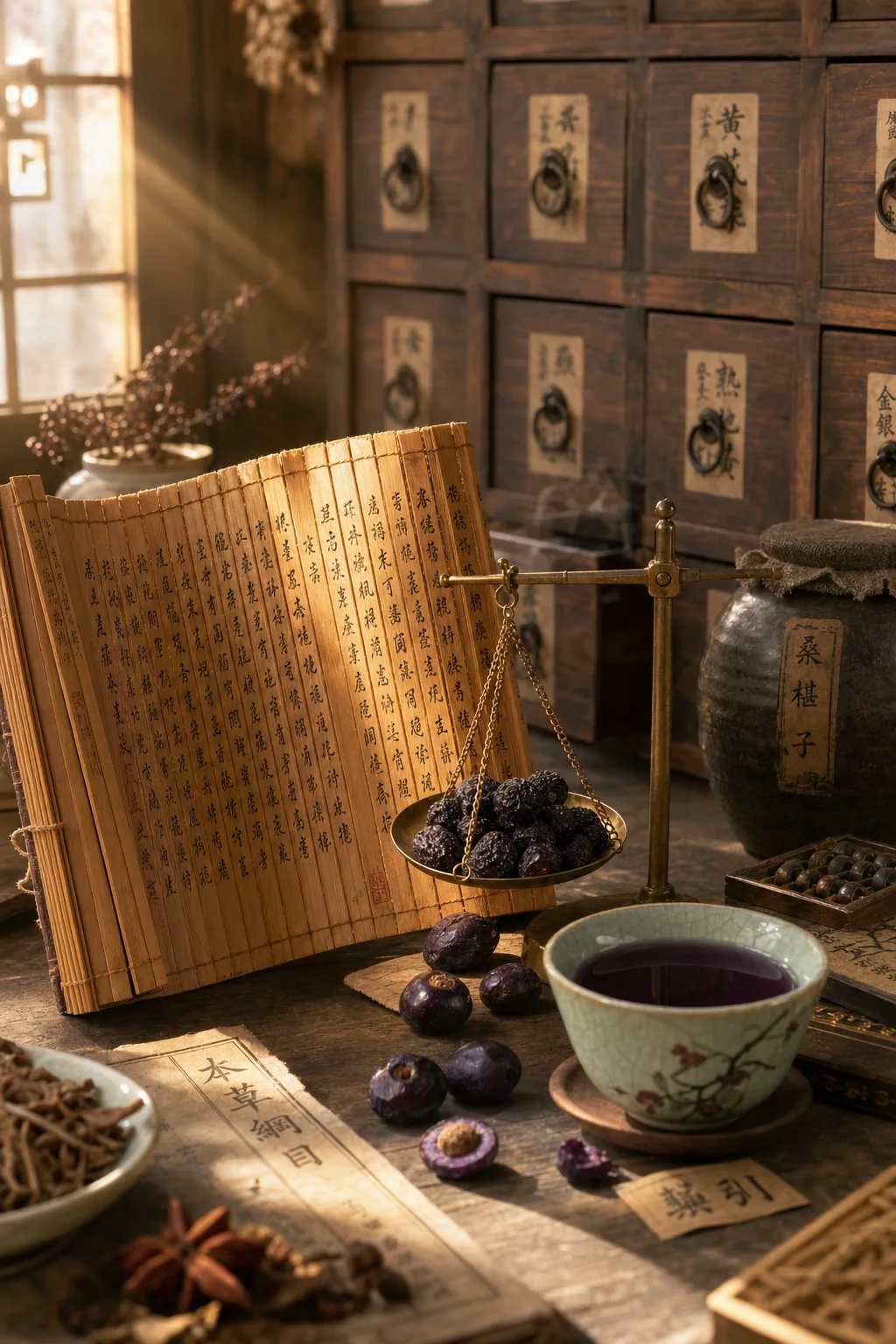
Two healing traditions, separated by the Himalayas, looked at the same disease and arrived at almost the same prescription. In China it was called Xiao Ke: Wasting-Thirst. In India it was Madhumeha: honey-urine. Both turned to cooling, astringent, dark fruits.
The Chinese name for jamun
In Chinese pharmacology, Syzygium cumini appears under two principal names: 乌墨 (wū mò, "black ink"), an evocative reference to its near-black ripe fruit, and 海南蒲桃 (Hǎinán pútáo, "Hainan rose-apple"), reflecting its naturalised distribution in the southernmost Chinese provinces (Zhongyi.ch overview of diabetes in TCM).
Jamun is not native to the historical core of China, and it is not a primary herb in the classical Materia Medica compilations such as the Ben Cao Gang Mu of Li Shizhen (1596). But in Yunnan, Guangdong and Hainan — where the tree naturalised after introduction from the south — it has entered folk medical practice, where it occupies an interesting place in the TCM diagnostic framework.
Xiao Ke: the Wasting-Thirst syndrome
In Traditional Chinese Medicine, what modern medicine calls diabetes mellitus was, for at least two thousand years, recognised under the name 消渴 (Xiāo Kě) — "Wasting and Thirsting." The clinical picture is identical to what Charaka described under Madhumeha: excessive thirst, excessive urination, progressive weight loss, and, in advanced cases, the loss of sweetness from the body to the urine.
TCM divides Xiao Ke into three clinical patterns based on the dominant symptom and the affected organ system:
| Pattern | Chinese | Dominant symptom | Affected organ |
|---|---|---|---|
| Upper Wasting | 上消 Shàng Xiāo | Polydipsia (excessive thirst) | Lung Yin deficiency |
| Middle Wasting | 中消 Zhōng Xiāo | Polyphagia (excessive hunger) | Stomach heat |
| Lower Wasting | 下消 Xià Xiāo | Polyuria (excessive urination) | Kidney Yin deficiency |
The classical TCM treatment principle for all three is: "清热润燥, 养阴生津" — "clear heat, lubricate the dryness, nourish the Yin and body fluid" (Zhongyi.ch summary). A herb suitable for Xiao Ke must therefore be cool, moistening, and capable of restraining the loss of body fluids.
Jamun's TCM property profile
Read against the TCM five-element framework, jamun's property profile fits Xiao Ke almost perfectly:
| TCM property | Pinyin | Jamun's value | Ayurvedic equivalent |
|---|---|---|---|
| Nature (Xing 性) | Han 寒 | Cold | Sheeta Virya |
| Taste (Wei 味) | Suān 酸 / Sè 涩 | Sour, astringent | Amla + Kashaya Rasa |
| Channel entered | — | Stomach, Kidney | Mutravaha + Annavaha srotas |
| Action | — | Clears Stomach heat, generates Body Fluids, restrains urine | Kapha-Pitta hara; Mutrasangrahaneeya |
This is not an accidental overlap. Both traditions developed sophisticated clinical descriptions of what we now call type-2 diabetes, and both — independently — converged on the same therapeutic logic: cool the system, contract the channels, replenish the fluids. The herbs they selected to do this work, drawn from radically different floras, share remarkably similar phytochemical signatures: tannin-rich, anthocyanin-rich, and astringent.
Yin deficiency and the polyphenol case
The TCM concept of Yin deficiency — broadly, the depletion of cool, moistening, restorative essence — maps in modern biomedical terms onto a constellation of oxidative-stress and inflammatory markers that predict diabetic complications. The herbs that nourish Yin are, almost without exception, rich in polyphenols and anthocyanins.
A 2023 systematic review in Chinese Medicine traced this continuity from classical Xiao Ke treatments to modern herbal antidiabetics, showing that the mechanisms TCM described intuitively (Yin deficiency → excess heat → wasting of fluids) match the biomarkers modern medicine measures (oxidative stress → inflammation → β-cell dysfunction → hyperglycaemia) (PMC10288731 — Chinese Medicine 2023).
Jamun's jamboline, jambosine, quercetin, myricetin and anthocyanin load — the same molecules profiled in the diabetes literature — are, in TCM terms, doing the work of "nourishing Yin and generating fluids." The vocabularies differ; the targets do not.
The wider Asian herbal exchange
Although jamun is not a foundational herb of classical Chinese Materia Medica, it sits within a broader Asian network of dark, astringent fruits used for the same indication. Compare:
- Black mulberry (Morus nigra, 桑椹 sāng shèn) — TCM tonic for Yin and blood, used for Xiao Ke; rich in anthocyanins and resveratrol.
- Cherokee plum and Chinese plum (Prunus salicina) — astringent fruits used in late-imperial Chinese folk medicine for diabetic-spectrum complaints.
- Schisandra berry (Schisandra chinensis, 五味子 wǔ wèi zǐ) — sour, astringent, with five tastes; used to nourish Yin and restrain leakage of body fluids.
Jamun, when adopted into folk practice in southern China, slipped naturally into this category. Its dark colour, sour-astringent taste, and cooling action made it phenomenologically obvious to a TCM practitioner what it would treat.
A note on textual citation
The specific inclusion of Syzygium cumini by Li Shizhen in the Ben Cao Gang Mu, or by earlier Chinese pharmacologists, is not confirmed in available English-language sources. This article treats jamun's TCM compatibility as a framework analysis, not a classical-text citation. The framework holds; the citation history requires specialist consultation with classical Chinese botanical pharmacopoeia.
Why this convergence matters
When two great medical traditions — independent in language, philosophy and pharmacopoeia — converge on the same herb for the same condition, the convergence is a signal. Modern pharmacology has spent the last three decades vindicating both traditions, molecule by molecule. The Ayurvedic Sheeta Virya and the Chinese Han Xing describe the same temperature-of-action that polyphenols and anthocyanins exert on inflamed tissue. The Mutrasangrahaneeya class and the "restrain leakage of body fluids" doctrine describe the same astringent contraction that tannins perform on overactive secretory epithelium.
You can read the science. Or you can read the manuscripts. They will tell you the same thing: jamun cools, contracts, and restores.