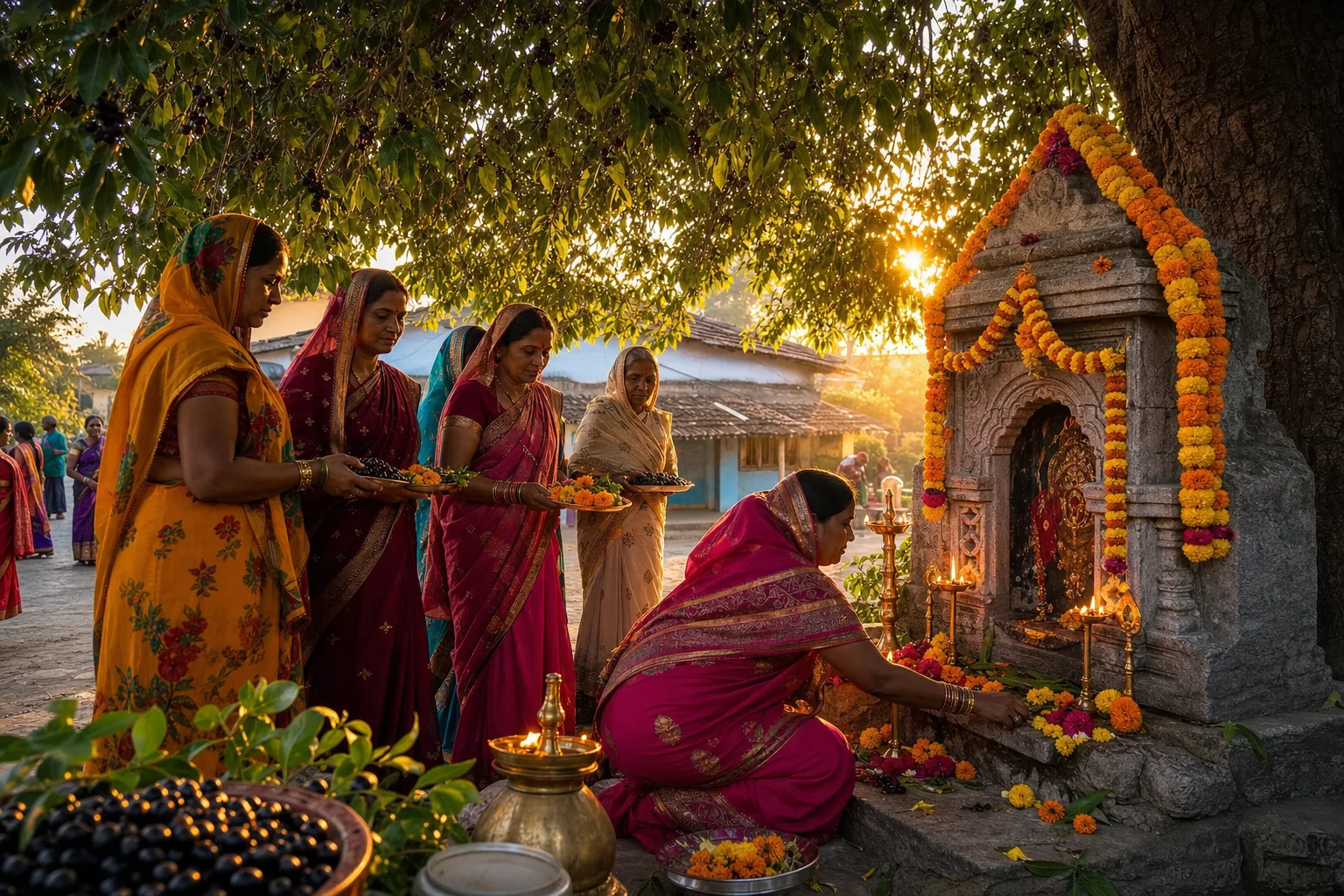
Few medicinal fruits have travelled as far as jamun. Carried first by Hindu-Buddhist seafarers, then by Portuguese and Dutch colonisers, jamun naturalised across three continents. The names changed; the indications stayed remarkably constant.
One fruit, many names
Wherever jamun went, the language of the receiving culture absorbed it. The vocabulary tells the story of its journey:
| Region | Local name | Language family |
|---|---|---|
| India (Sanskrit / Hindi) | Jambu / Jamun | Indo-Aryan |
| Andhra Pradesh / Telangana | Neredu Pandlu | Dravidian |
| Tamil Nadu | Naval | Dravidian |
| Kerala | Njaaval | Dravidian |
| Bengal | Kala Jam | Indo-Aryan |
| Sri Lanka (Sinhala) | Naval / Madan | Indo-Aryan |
| Indonesia / Malaysia | Jamblang, Duwet | Austronesian |
| Philippines (Tagalog) | Duhat | Austronesian |
| Philippines (Bisaya) | Lomboy | Austronesian |
| Brazil (Portuguese) | Jambolão, Jamelão | Romance, via Sanskrit |
| Madagascar (Malagasy) | Rotra | Austronesian |
Notice the linguistic trail. The Portuguese Jambolão is a direct loan from Sanskrit Jambula, brought to Brazil by colonisers who had picked up the fruit and its name on the Konkan coast. The Indonesian Jamblang and the Filipino Duhat emerged independently within Austronesian languages, reflecting much older trade contacts between South India and Southeast Asia.
Indonesia: jamun in the Jamu tradition
Indonesia's Jamu herbal medicine tradition — recognised by UNESCO in 2023 as an intangible cultural heritage — has been practised since the Mataram Kingdom of the 13th century and probably earlier (UNESCO listing for Jamu wellness culture). The tradition operates on a binary classification of "hot" and "cold" conditions that runs parallel to the Ayurvedic Virya system and the Chinese Xing.
Jamun (Jamblang or Duwet) is classified as a "cold" fruit in Jamu, appropriate for "hot" conditions — fever, inflammation, urinary heat and diabetes. It is integrated into the Jamu materia medica alongside other Myrtaceae such as clove, cardamom and rose-apple. The pan-tropical naturalisation of jamun in Java, Bali, and Sumatra means that for at least four centuries the fruit has been part of regional medicine.
The Philippines: Duhat and Lomboy
In the Philippines, the jamun tree — known as Duhat in Tagalog and Lomboy in Bisaya — is a familiar feature of village landscapes. The fruit is consumed widely, but the seeds carry the principal therapeutic significance: Filipino traditional medicine documents seed decoctions for blood-sugar management, mirroring the Ayurvedic and Unani use (UF/IFAS plant directory).
Wikimedia Commons preserves multiple photographic records of mature Duhat trees in community settings — most notably in Santa Trinidad, Angeles City, and Bocaue in Bulacan — testifying to the tree's status as both a productive food crop and a shade-giving fixture of the Filipino countryside (Wikimedia Commons category Syzygium cumini).
Sri Lanka: Hela Wedakama
Sri Lanka has its own indigenous medical tradition, Hela Wedakama, which Wikipedia describes as:
A mixture of Sinhala traditional medicine, mainland Ayurveda and Siddha systems of India, Unani medicine of Greece through the Arabs, and most importantly, the Desheeya Chikitsa, which is the indigenous medicine of Sri Lanka. Wikipedia — Sri Lankan traditional medicine (source)
According to a tradition preserved in the island's medical lineages, the system was founded by King Ravana, who used panchangaya — five-part preparations using the flower, fruit, leaf, bark and root of trees — for healing rituals (Adhitya Ayurveda — Hela Wedakama).
In Sri Lanka, jamun (Naval in Sinhala) is used in folk medicine for children's digestive complaints — fresh leaves are soaked overnight in water and the infusion is given to children for gastrointestinal infections. The fruit features in the Sri Lankan chronicle Mahavamsa, where King Samgatissa is reported to have eaten jamun fruits in a famous narrative episode (Tamil and Vedas — Jambu tree compilation).
Brazil and South America: Jambolão
The most remarkable transatlantic story is jamun's establishment in Brazil. Portuguese colonisers, having encountered the fruit and its Sanskrit name on the Konkan coast of India, introduced it to Brazil during the 16th–17th centuries. There, the tree naturalised rapidly across tropical South America under the name Jambolão (sometimes Jamelão).
The comprehensive ethnobotanical review by Ayyanar and Subash-Babu (2012) documents extensive use across multiple Brazilian communities:
| Brazilian community | Use | Preparation |
|---|---|---|
| Local people, southern Brazil | Diabetes | Leaf infusions/decoctions at 2.5 g/L, ~1 litre/day |
| Quilombolas (Afro-Indigenous), Northeast | Diabetes, renal | Leaf decoction, oral |
| Rural Brazilian population | Diabetes | Leaf oral preparations |
| Traditional healers | Diabetes | Tea from leaf infusion or decoction |
| Afro-Brazilian communities | Jams, juices, folk medicine | Fruit consumption and preparation |
Source: Ayyanar & Subash-Babu, 2012 (PMC3609276).
The Brazilian engagement with jamun has become a serious research programme. Brazilian universities — notably the research group of Chagas, França, Malik and de Andrade Paes — have produced some of the most rigorous modern phytopharmacology on Syzygium cumini, including the influential 2015 review in Frontiers in Pharmacology that positioned jamun as "a prominent source of bioactive molecules against cardiometabolic diseases" (PMC4630574).
Madagascar: traditional diabetic therapy
Madagascar lies in a similar tropical band to Indonesia and Brazil. Jamun naturalised there centuries ago, and Malagasy traditional healers have used S. cumini seeds for generations as therapy for diabetes mellitus — a practice independently documented by Ayyanar and Subash-Babu (PMC3609276).
Africa, the Caribbean and the Pacific
Jamun has now naturalised across the tropics. It is present in East Africa, parts of the Caribbean (where it is called "Java plum" or "Damson plum"), Hawaii, and the Pacific Islands. In Hawaii, the Starr brothers' botanical photographic series — preserved on Wikimedia Commons — documents extensive naturalisation on Maui, where the tree is regarded as an invasive but useful fruit-bearer (Wikimedia Commons category).
The convergent indication
Strip away the names and the local medical vocabularies, and you find a startling convergence. Every culture that received jamun — Indonesian, Filipino, Sri Lankan, Brazilian, Madagascan, Caribbean — independently identified the same primary therapeutic indication: blood-sugar management.
This is not a case of one tradition borrowing from another. It is what happens when independent communities perform the same empirical experiment with the same plant and converge on the same observation. The molecules — jamboline, jambosine, the anthocyanins, the tannins — do not care which language the patient speaks.
Where SVBS sits in the global supply chain
The Konkan Bahadoli variety we grow is the Indian commercial standard. As global interest in jamun grows — from Brazilian universities to American nutraceutical formulators — the source of high-quality fruit remains, overwhelmingly, the western and southern Indian belt. Our 40-acre orchard near Madanapalle, in the heart of the Rayalaseema region, supplies wholesalers, processors, and exporters working in this expanding international market.