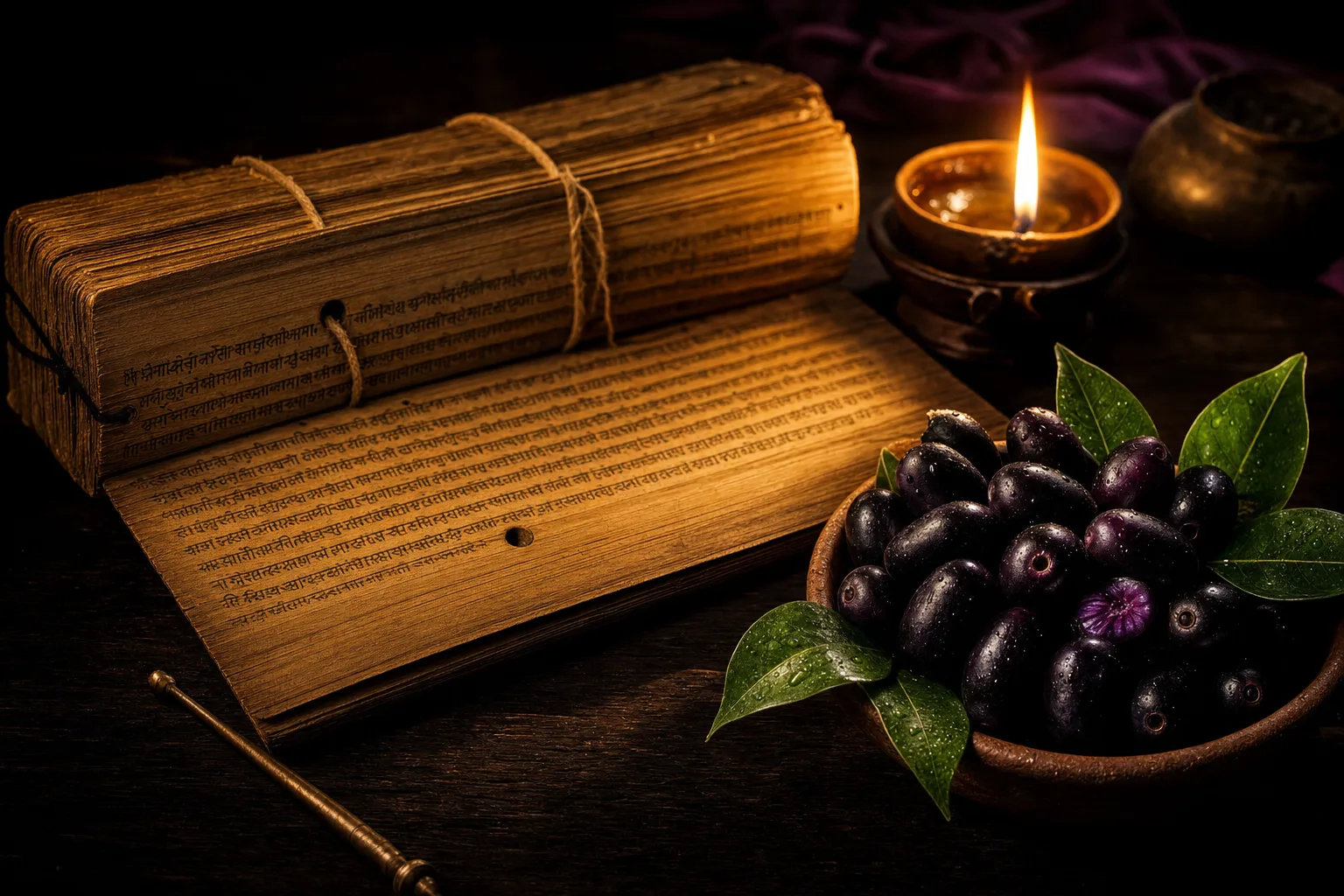
A tropical Indian fruit travelled westward along the Silk and Spice Routes and was absorbed — with characteristic precision — into the Greco-Arabic medical tradition the Mughals had inherited from Persia. There, jamun became a hepatic tonic, an astringent for the bowels, and a remedy for what Hakims called al-sukkar — diabetes.
What Unani is
The Unani system — or, more properly, Tibb-i-Yūnānī, "the medicine of the Greeks" — is the medical tradition that descends from Hippocrates and Galen, was preserved and developed by Arab and Persian scholars during the Islamic golden age (8th–13th centuries), and was carried to South Asia by Arab traders and later by Mughal courts. It is one of the AYUSH systems formally recognised by the Government of India, and it shares with Ayurveda a humoral framework — though the four-humour Galenic system (blood, phlegm, yellow bile, black bile) is conceptually distinct from the three-dosha system.
What Unani and Ayurveda share is a profoundly important principle: every substance, including every herb, has a temperament (mizaj) that is classified on the axes of hot–cold and wet–dry. A correctly chosen remedy is one whose temperament opposes the imbalance of the patient (PMC10379789 — Mizaj indices in Persian medicine).
Jamun's mizaj
In Unani classification, jamun is cold and dry — bārid wa yābis. This is identical, in effect, to the Ayurvedic Sheeta Virya (cold potency) plus Ruksha Guna (dry quality). The temperament classification is so consistent across systems that it is almost certainly empirical — both traditions, working independently, arrived at the same observation that jamun cools heat and dries excess moisture from the tissues (Tehran Times — Mizaj classification).
How jamun entered Unani practice
Jamun is a tropical Asian native, not a Mediterranean or Central Asian plant. It is therefore absent from the classical Greek pharmacopoeia of Dioscorides and Theophrastus, and from most of the Arabic medical literature produced in the central Islamic heartland.
The plant entered Unani practice through the Mughal-era encounter between Persian-trained physicians and Indian traditions. The Hakims who served Mughal courts — many trained in Persian medical academies — encountered the Ayurvedic vaidyas of the subcontinent and, in a process well-documented by historians of medicine, integrated several South Asian plants into their materia medica. Jamun was one of the most important of these:
In traditional Unani medicine, Malabar plum was introduced via trade routes from the Mughal period, gaining reputation for balancing blood sugar levels. Ask Ayurveda — Syzygium cumini monograph (source)
The Unani indications for jamun
Once absorbed into the Unani pharmacopoeia, jamun's indications closely parallelled its Ayurvedic uses — but were re-described in the Unani vocabulary of organ function and humoral correction. The principal indications:
- Hepatic tonic — strengthens kabid (liver) function. The bark and seeds were the preferred parts. This is consistent with the modern hepatoprotective evidence: S. cumini peel extract reduces CCl₄-induced LDH leakage by 54% and enhances hepatocyte viability by 39% at 50 ppm (Toxicology in Vitro 2008).
- Astringent for bowels — qabiz, used in the management of loose stools and dysentery. Fruit and bark are both used. This is the same indication as the Ayurvedic Atisara and the Sushruta-prescribed seed-powder-with-buttermilk preparation.
- Blood-sugar regulation — primarily seed powder. The Unani textbooks describe jamun as among the few plants suitable for the chronic management of al-sukkar (sweet urine).
- Cooling for febrile conditions — the fruit pulp's bārid (cold) temperament makes it appropriate for heat-driven illness, parallel to the Ayurvedic Daha-prashamana action.
The Ayyanar–Subash-Babu confirmation
The authoritative comprehensive review of jamun's traditional uses, by Ayyanar and Subash-Babu in 2012, confirms the Unani hepatic indication explicitly:
In Unani medicine various parts of jambolan act as liver tonic. Ayyanar & Subash-Babu, 2012, Asian Pacific Journal of Tropical Biomedicine (PMC3609276)
Avicenna and the Canon — a careful note
Ibn Sina (980–1037 CE) — known in Latin Europe as Avicenna — compiled Al-Qanun fi'l-Tibb (The Canon of Medicine), the most influential medical text in the medieval Islamic world (Wikipedia — Canon of Medicine). The Canon described hundreds of plants and their temperaments.
Avicenna lived in Bukhara and Hamadan, well to the north of the jamun's native range. Arab traders who travelled to India from the 8th century onward would certainly have encountered the fruit, but a direct citation of Syzygium cumini (under any of its possible Arabic names) in available English translations of the Canon has not been definitively confirmed. Some scholarly traditions assert that Book 2 of the Canon describes al-jāmūn (جامون) as an astringent fruit used for bowel management, but this assertion requires verification against the Arabic primary text.
Transparency on sourcing
Several Unani and Persian-medicine attributions for jamun are well-attested in modern Unani-Tibb practice and in twentieth-century compilations of the Unani materia medica, but their direct citation in pre-Mughal classical Persian and Arabic texts is not confirmed in available English-language scholarship. This article treats the Unani reception of jamun as a Mughal-era integration — historically firm — without overstating the depth of the classical Persian textual evidence.
Itrifal: the compound formulary
The Persian-Unani tradition is distinguished by its extensive use of itrifal — compound preparations combining astringent, sour and aromatic fruits, often macerated in honey, for the chronic management of digestive and urinary complaints. The classical Itrifal Sagheer and Itrifal Kabeer blend three myrobalan fruits (Triphala's Persian cousin) — halileh, balileh, and amleh. Jamun, with its identical astringent profile and complementary cooling action, fits naturally into this category, and modern Unani-Ayurvedic compound preparations frequently combine jamun seed powder with these myrobalans for diabetic management.
The continuity of empirical observation
What the Unani case demonstrates is the same point that the Ayurvedic and Chinese cases demonstrate: three independent medical traditions, observing the same patient under the same disease, converged on the same plant. The Hakim writing al-sukkar in Persian, the Vaidya writing Madhumeha in Sanskrit, the Chinese practitioner writing Xiao Ke in hanzi — all three reached for a cold, astringent, dark-purple fruit and prescribed it for the same wasting condition.
Modern pharmacology has spent the last forty years explaining, in the vocabulary of α-glucosidase inhibition and PPAR-γ activation, what those three traditions had already established by direct clinical observation a thousand years before.